


EMC: Time, Temperature, Relative Humidity
Equilibrium moisture content (EMC) is a key concept in wood flooring, and three factors come into play: time, temperature, and relative humidity.
Understanding EMC helps you install wood floors that last.
In this article we’ll cover:
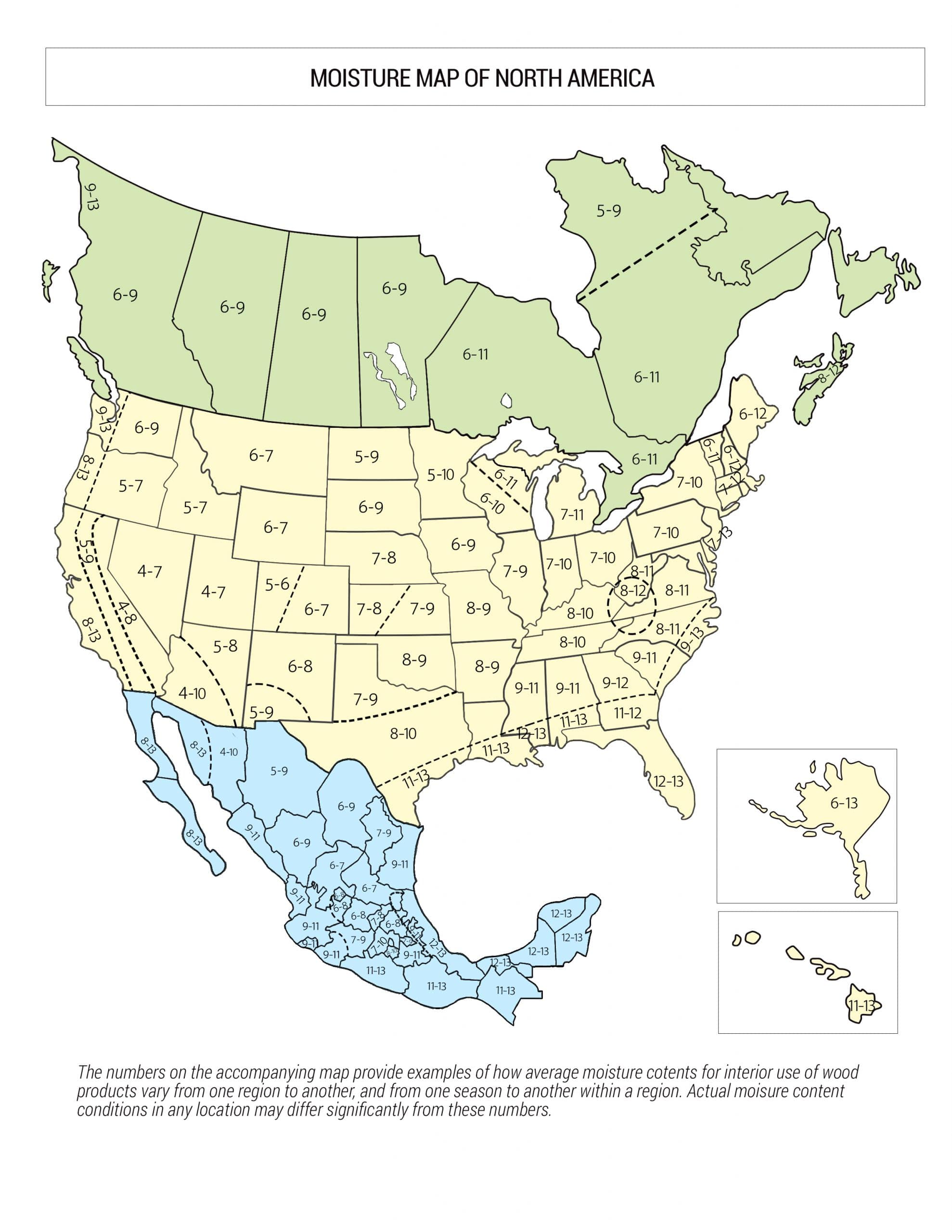
- What Does EMC Stand for and What is EMC?
- The EMC Formula
- Relative Humidity (RH)
- Temperature
- Put Time on Your Side
Here’s how each of these factors affects wood flooring.
What Does EMC Stand for and What is EMC?
Equilibrium moisture content, or EMC, is the moisture content at which wood is in balance with the surrounding air, so it no longer gains or loses moisture.
EMC is a balancing act between the wood and its surroundings. Raise the relative humidity (RH), and the wood absorbs moisture from the air; lower it, and the wood releases moisture into the air.
Why does it matter?
Since wood has a hygroscopic (moisture-interactive) relationship with its environment, changes in the wood’s moisture content (MC) will also cause corresponding changes to the wood’s physical dimensions. When wood absorbs moisture, the wood cells expand to accommodate the extra moisture. When it releases moisture, it shrinks.
If these changes happen after a wood floor is installed, they may cause only some seasonal gaps, but they can also lead to more serious moisture problems like cupping, crowning, and splitting.
The EMC Formula
Put simply, the two environmental factors that determine EMC are the temperature and the RH of the air in the space where the flooring will be installed.
The exact EMC formula is complex, so most people use an EMC table or a calculator, such as Wagner’s EMC calculator or the free Wood H2O app.
To see the EMC formula and an EMC chart, read our article all about EMC.
Here are some general recommendations for the job site, but always follow the flooring manufacturer’s acclimation guidelines:
- The space where the flooring will be installed should have adequate ventilation, and the HVAC system and any humidifiers that are part of the design should be running, typically for 5 to 7 days, before the flooring is delivered. Other materials, like concrete or plaster, should also be dry before the flooring comes on site.
- The flooring needs to be exposed to these conditions to acclimate. If the manufacturer’s instructions allow, open the packaging and stack the boards with thin strips between them so air can circulate around each board.
- As you stack, measure the flooring with a wood moisture meter (we recommend pinless moisture meters, which don’t damage the wood) and find the EMC for your area and season with an EMC table or calculator.
It’s also a good idea to keep a thermo-hygrometer on site to confirm that the temperature and humidity are stable.
Relative Humidity (RH)
The RH of the air around the flooring has the greatest effect on wood MC. As mentioned, wood is a hygroscopic material that readily absorbs and releases moisture.
When the RH rises, the wood absorbs moisture until it reaches a new balance with the surrounding air.
When the RH drops and the wood’s MC is above the new EMC, the wood releases moisture into the air. It helps to know which way your wood’s MC will be moving as it acclimates.
Temperature
Temperature matters to wood MC mostly because of how it affects the RH of the air. Warming air without adding moisture lowers its RH, and cooling it raises the RH. If the temperature on the job site keeps changing, the EMC keeps moving too, so keep conditions stable while the flooring acclimates.

Free Download – 6 Reasons Your Wood Project Failed
Put Time on Your Side
From this point on, the key to acclimating wood flooring successfully is time. Why?
If moisture changes happen too quickly, wood may warp, split, or twist as different faces of the board absorb or lose moisture at different rates. For example, end grain absorbs moisture faster because it’s cut across the wood cells, which are shaped like bundled drinking straws.
Some manufacturers recommend a number of days for acclimation, but the best way to confirm the flooring has reached the right MC is to measure it with an accurate wood moisture meter.
Wagner’s pinless meters are simple to use and don’t mar the flooring.
With species settings for both domestic and exotic woods, our pinless wood moisture meters can scan many board feet quickly, so you can track the wood’s progress toward EMC.
Once the wood’s MC has stabilized at the right level, you can install it with much more confidence that the floor will hold up.
As wood moves toward EMC on any new site, temperature and RH determine how much moisture it must absorb or release, but time is what separates a good moisture balance from moisture-related flooring problems.

Tony Morgan is a senior technician for Wagner Meters, where he serves on a team for product testing, development, and also customer service and training for moisture measurement products. Along with 19 years field experience for a number of electronics companies, Tony holds a B.A. in Management and his AAS in Electronics Technology.
Last updated on October 20th, 2026

 800-634-9961


recently moved into a new home. Our new floors are now experiencing cupping. Assuming instalation was done properly I am wondering if certain paint used on trim can have an effect on the wood. The trim is painted with a semi gloss and seems not yet to be throughly hardened. Not sticky to the touch but when running my hand down the door trim in some places there is a slight pull. It has been well past 6 months.
Hi Karen. Here is the most likely cause and cure as quoted from a wood floor technical publication.
Cupping occurs across the width of the individual pieces of flooring. The edges are high and the center is lower. It generally develops gradually.
Cause:
• A moisture differential within individual pieces of flooring, usually excessive moisture on the underside of the flooring. More subtle cupping can be caused by lack of proper acclimation (this is generally permanent cupping).
Potential sources of excessive moisture include:
– Building leaks
– Poor drainage
– Plumbing leaks or overflows
– Leaks from dishwashers or refrigerator icemaking units
-Wet or damp basements/crawlspaces
-Concrete subfloors that have not cured
-Plywood subfloors with excessive moisture
-Poor or no ventilation
-HVAC system not operating.
• Flooring also may cup when a wood floor experiences conditions that cause rapid drying on the surface. This condition occurs with gaps as the flooring shrinks.
Cure:
Never attempt to repair a cupped floor until all of the sources of excessive moisture have been located and eliminated. This can be verified only with a moisture meter that takes readings of the underlying subfloor.
As long as the wood is not permanently deformed or damaged, the flooring will return to its original shape and size when the excessive moisture is removed. This may take weeks, months, or even an entire heating season.
Attempting to sand a cupped floor while it is still too wet may cause subsequent crowning when the floor dries. Flooring that does not return to its original shape, even after completing an entire heating season, probably is permanently deformed. (Taking moisture readings at different levels in the wood flooring also can help determine this—if there is a gradient of 1 percent or more between the top and bottom of the boards, they probably are not done drying.) If the boards are permanently deformed, the cupped edges may be sanded off.
For floors that have cupped due to drying, relative humidity should be increased. Relative humidity below 20 percent is considered very dry for wood flooring, and it is suggested that humidification be provided under such conditions.