



What Is Specific Gravity of Wood?
When we talk about wood, most of us focus on its color, grain, and finish. But for people who work with wood professionally, another property matters just as much: the specific gravity (SG) of the wood.
It’s an important concept that’s often overlooked. This article explains what specific gravity is, why it matters, and how it affects moisture meter readings.
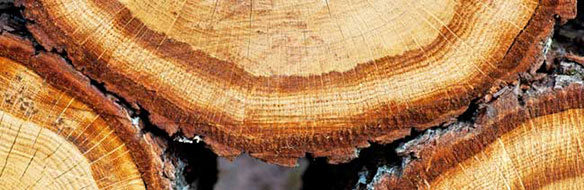
When you work with different wood species, specific gravity is an important concept, but it isn’t always well understood.
Specific gravity applies to any substance, but in this article, we’ll look at it as it relates to wood.
What Is Specific Gravity
Specific gravity is the ratio of a material’s density to the density of water. Because water has a density of 1 gram per cubic centimeter (1 g/cm3), a material’s specific gravity is essentially its density in grams per cubic centimeter. Anything with a specific gravity below 1.0 is lighter than water, and anything above 1.0 is heavier.
Wood is made up of cells composed mostly of cellulose, hemicellulose, and lignin, along with smaller amounts of other substances that vary by species. How much cell wall material a piece of wood contains, compared with the empty space inside and between its cells, largely determines its density.
Woods with thick cell walls and little empty space are denser and have a higher specific gravity. Woods with thin cell walls and more open space are lighter and have a lower specific gravity.
Why is Specific Gravity Important
The amount of moisture in wood affects its weight. More importantly for woodworking, it affects the dimensions of a finished piece as the cells swell or shrink with changes in moisture content, and it affects how the wood reacts to finishes.
Water in wood is held in the cell walls and in the cavities within and between the cells.
If you think of a piece of wood as a bundle of very thin straws, each with a wall and a hollow center running along its length, you’ll see why water can keep moving in and out of the wood long after the tree is cut, as long as the wood isn’t sealed.
That’s where specific gravity comes in. Because both the weight and the volume of wood change with moisture content, the specific gravity of wood is always based on its oven-dry weight, divided by its volume at a stated moisture content (commonly oven-dry, green, or 12%).1 Within a species, specific gravity is fairly consistent.
Whether a piece of wood floats or sinks in water gives a rough idea of its specific gravity, since woods with a specific gravity above 1.0 sink.
Specific Gravity Formula
The basic formula for the specific gravity of wood is:
SG = Wd ÷ (V × density of water)
where Wd is the oven-dry weight of the wood and V is its volume at the stated moisture content.
A related formula shows how moisture content affects a piece of wood’s weight:
W = Wd(1 + M/100)
where W is the weight at moisture content M (in percent) and Wd is the oven-dry weight.
Moisture meters measure the moisture content of wood. But a meter that doesn’t allow for species corrections or species settings can’t give you accurate readings across different woods, because species vary widely in density. According to the USDA Forest Service’s Wood Handbook, the oven-dry density of wood ranges from about 160 kg/m3 for balsa (a specific gravity of about 0.16) to more than 1,040 kg/m3 for some imported species (a specific gravity above 1.0).1 That’s a big difference!
 Free Download – 5 Ways Pinless Moisture Meters Save You Time and Money
Some meters handle specific gravity with species correction tables, printed charts you use to look up and adjust the meter’s reading by hand. Others, like Wagner’s Orion® line of pinless meters, let you set the specific gravity for a wide range of softwoods and hardwoods, so you get a corrected reading right on the display.
With a basic understanding of specific gravity and a moisture meter that uses specific gravity settings, you’ll get more accurate moisture readings and better results in your woodworking.
Understanding specific gravity isn’t just academic. It affects how wood feels and behaves, how it responds to moisture, and how it takes finishes, and it’s one detail woodworkers can’t afford to overlook.
Find the specific gravity for your wood species.

As Sales Manager for Wagner Meters, Ron has more than 35 years of experience with instrumentation and measurement systems in different industries. In previous positions, he has served as Regional Sales Manager, Product and Projects Manager, and Sales Manager for manufacturers involved in measurement instrumentation.
Last updated on October 8th, 2026

 800-634-9961


Hello, I was wondering if you can input a custom specific gravity if the species you are measuring cannot be found on the species tables? If I get one of your moisture meters I would like to measure the moisture content of Ancient Redgum from Australia, but I cannot find that on your species specific tables. So is there a way to, without having to select a certain species, input a custom specific gravity value?
Chloe, what model of Wagner moisture meter are you using?
I am having a friend make a pool cue but for me. Is higher SG better for this project ? Also I am going to purchase snakewood but the piece is not dried, should I only punched dried wood to prevent warpage, I am thinking about Snakewood but the piece I wan’t is not dried. I this a concern ? Thank you for you time. Sincerely AJ
The wood must be dried to approximately 8-10% moisture content for whatever species is used. A very high SG is not necessarily better or worse. Most pool cues are made from hard rock maple.
can u explain the example of application in wood products in specific gravity and density
You talk about sg, but you only say “Specific gravity for woods is determined by measuring the weight at a specific moisture content level.” That doesn’t explain anything unless you tell us what specific moisture content level you use for test specimens – is it wood completely devoid of moisture or mc=7%, or what is your starting datum point Used to determine sg?
More than a week ago I posted a comment re the SG of mahogany. To date there has been no response. You request comments and the ignore them.Why do I waste my time?
Hi Denis,
Unfortunately, your first comment either didn’t come through or possibly got marked spam. Can you please ask your question again. Thanks and our apologies.