


Temperature’s Impact on Wood Moisture Content
If you want to take accurate wood moisture measurements, you need to understand how ambient temperature, relative humidity, and wood moisture content interact.
But that’s not all.
You also need to understand how temperature affects your wood moisture meter, because temperature doesn’t affect pin-type and pinless meters the same way. We’ll talk more about this in a bit. But first, let’s go over some basics about temperature and wood moisture content.
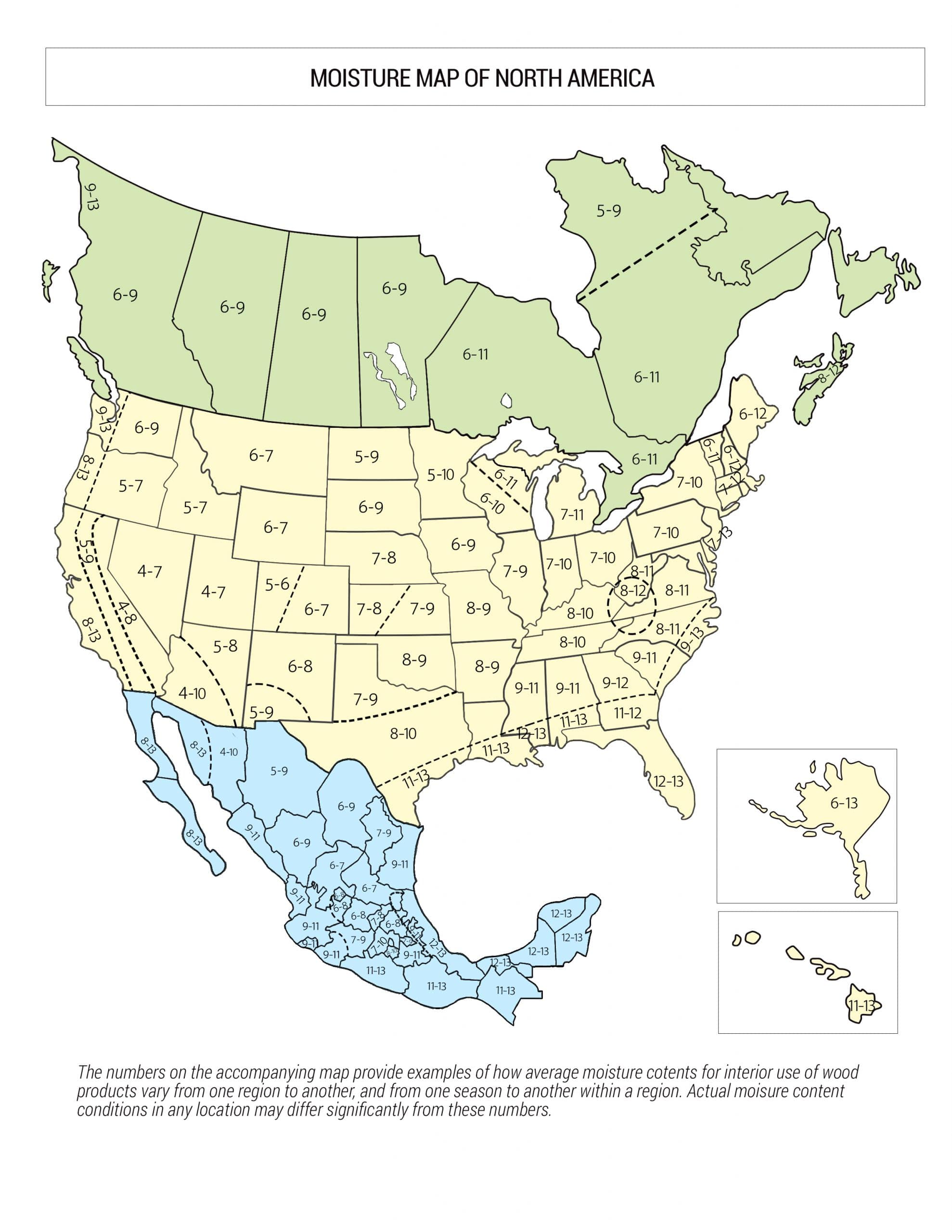
- How Do Temperature and Humidity Affect Wood?
- Relative Humidity and Wood Moisture Content
- How Does Moisture Affect Wood?
- How Temperature Affects Your Wood Moisture Meter
How Do Temperature and Humidity Affect Wood?
First of all, what do we mean when we talk about the moisture content of wood? Let’s quickly go over the answer to that before we continue.
The moisture content (MC) of wood equals the weight of the water in the wood divided by the weight of the oven-dry wood, multiplied by 100 to express it as a percentage. Note that it’s possible for the moisture content to be over 100% if the water present in the wood weighs more than the wood itself.
Now let’s talk about how temperature and humidity affect wood.
Relative humidity has a much greater effect on wood’s moisture content than temperature does. Temperature’s direct effect is small; its bigger influence comes through the way it changes the relative humidity.
If you placed a piece of wood flooring in a room where the temperature rose and fell while the relative humidity stayed constant, its moisture content would change only slightly.
But if the temperature stayed constant while the relative humidity rose and fell, its moisture content would rise and fall with it. You can see this for yourself in an equilibrium moisture content (EMC) table.
So, why does relative humidity have a greater impact on moisture in wood than temperature? Let’s find out.
Relative Humidity and Wood Moisture Content
Wood is a hygroscopic material. That means it’s constantly reacting to changes in its environment by absorbing and releasing moisture.
If the wood’s MC is lower than the EMC for the surrounding temperature and humidity, the wood absorbs moisture from the air until it reaches that EMC. The reverse is also true.
In a dry environment, wood releases moisture until it reaches balance. That balance point, where the wood is neither gaining nor losing moisture, is the EMC.
So it’s mainly the relative humidity, not the temperature, that changes the moisture content of wood.
Prior to putting down hardwood flooring, building a cabinet, or any other project, wood needs time to adjust to the environment where it will be used. In other words, it needs time to reach EMC. Skipping this step can cause moisture-related problems later, because wood shrinks as its moisture content drops and swells as it rises.
We’ll go into more detail about this in the next section. But, before we do that let’s talk a bit more about how water gets into wood.
Moisture moves through wood as water vapor through the cell cavities (lumens), as bound water diffusing through the cell walls, and as liquid water drawn along by capillary action. You’ve probably seen capillary action yourself.
For example, if you roll up a paper towel and stand it in a glass of water, the water climbs up the towel. That’s capillary action.
How Does Moisture Affect Wood?
Moisture content directly affects wood’s physical dimensions. The give and take of moisture with the surrounding air that we talked about earlier makes wood swell or shrink.
If dried wood isn’t allowed to properly acclimate to the place where it will be used, that give and take will continue even after the project is complete.
This can lead to gaps, buckling, crowning, splits, or other problems, depending on the type of project.
Wood is anisotropic
Anisotropic means that as wood absorbs and releases water, it swells and shrinks by different amounts in its three directions: tangential, radial, and longitudinal (along the grain).
For example, as wood dries from green to oven-dry, it shrinks an average of about 8% tangentially, but only about 4% radially. According to the USDA Forest Service Wood Handbook, tangential shrinkage is about twice the radial shrinkage, and shrinkage along the grain is only 0.1% to 0.2% for most species.
Wood’s density affects shrinkage and swelling
In general, denser woods shrink and swell more with changes in moisture than lighter woods.

Free Download – 6 Reasons Your Wood Project Failed
Dry wood is stronger than wet wood
As wood dries below the fiber saturation point, most of its strength properties increase. Wood dried to around 12% MC is much stronger than freshly cut green wood, and in some properties, such as compression strength along the grain, it can be nearly twice as strong.
Wood doesn’t like excessive moisture and high humidity
Mold can grow on wood surfaces when the surface relative humidity stays above about 80% for long periods, and most molds grow at temperatures above about 40°F (4°C). Decay is a bigger problem. According to the Wood Handbook, decay fungi generally need wood at or above its fiber saturation point (usually about 30% MC) and temperatures between 50°F and 100°F (10°C and 43°C). Humid air alone won’t wet wood enough to decay; it takes liquid water from rain, condensation, leaks, or contact with wet ground. Keeping wood below 20% MC gives a reasonable margin of safety.
Below about 40°F, high humidity is less of a mold risk, as long as the wood dries out before temperatures rise again.

How Temperature Affects Your Wood Moisture Meter
If you’ve read this far, you have a basic understanding of how relative humidity, temperature, and wood moisture content interact. That knowledge will help you measure wood moisture content accurately in any weather.
Our free Wood H2O app can also help you quickly find the EMC for your project’s conditions, which helps you avoid moisture-related problems after construction or installation.
Now let’s talk about how temperature affects your wood moisture meter.
Pin-type wood moisture meters
Pin-type meters are sensitive to changes in wood temperature because of the technology they use.
Pin meters take moisture content readings by passing an electrical current between the pin tips and measuring the resistance. But as the wood’s temperature rises, its electrical resistance drops, which makes the moisture reading higher.
So for an accurate reading, you’ll need to correct for the wood’s temperature. Most pin meters come with instructions for doing this.
Pinless wood moisture meters
Because pinless wood moisture meters don’t rely on electrical resistance to measure moisture content, you don’t need to correct their readings for temperature, except at temperature extremes.
Relative humidity in the air also doesn’t significantly affect pinless readings unless there’s condensation on the meter. And Wagner’s Orion® pinless meters use IntelliSense™ technology, which helps keep surface moisture on the wood from skewing readings.
To prevent moisture-related problems in your wood projects, you need accurate moisture readings. And accurate readings depend on understanding how relative humidity, temperature, wood moisture content, and your moisture meter’s technology interact.
If you’re planning a construction or renovation project, also read about moisture content in wood studs.

Tony Morgan is a senior technician for Wagner Meters, where he serves on a team for product testing, development, and also customer service and training for moisture measurement products. Along with 19 years field experience for a number of electronics companies, Tony holds a B.A. in Management and his AAS in Electronics Technology.
Last updated on October 21st, 2026

 800-634-9961


What is the relationship between relative humidity of air, say 60%, and wood say 12%, which is pretty common in my shop. I run a dehumidifier, which maintains the shop humidity at 60%, and I use a microwave to dry my lathe turning projects to 12-14 percent?
Hi Arnold,
To best answer your question I’ll refer you to the following calculator and chart: http://www.csgnetwork.com/emctablecalc.html
Hope this helps you.
Hi,
In the last paragraph you speak about temperature extremes in relation to moisture measurement with pinless moisture meter.
What do you mean with temperature extremes? what is the temperature above which a pinless moisture meter won’t be reliable anymore?
Thanks,
Alex
Hi,
I was reading the various postings and have a similar but unique question/problem.
We kiln dry our wood to approximately 10%, both 1″ and 2″ thickness. We are using Teak.
We are located in an areas that is exceptionally wet and humid this time of year, 95% humidity is a normal day right now.
Once the wood is removed from the kiln, how long will it take for the current humidity to increase the lumber MC to above the 10% target?
If we are putting the wood into production within a couple of weeks of leaving the kiln, are we ok? Or should we be storing the wood in a climate controlled area of some sort until it is used?
It is our assumption that the issue is less of a problem once the wood is finished and sealed.
Thanks,
Ken Phillips
Hi Ken,
The wood will move up in moisture quickly at 95% RH, so should be stored in a controlled environment, but I suggest that they use their moisture meter to their advantage, and take readings immediately out of the kiln (but after the wood has cooled a bit), and then take readings every 24 hours for the next few days to determine the ramp rate.
Help!!!
Trying to acclimate some flooring and the crawl space to an appropriate level. It’s been three months. The wood is mahogany. It came in at 5% and I cannot get it to rise in the house. RH in the house has been between 35 and 45. Geothermal unit heats and cools the house.
The crawl space suffered an accident with a drain in March. Dehumidifier has been installed after clean up and encapsulated process. The RH is down to 55, and the temp is at 60. I believe a lot of this is due to the geo system is duct worked throughout the house. The drain actually drains under the house also. I was told to close off the outside vents which I did. At the time in Indiana it was hot and humid. The floor plywood is coming down. The main issue is getting the new wood above 5. Any suggestions would be helpful. Wood has been stored in the house for 3 1/2 months.
Today the outside temp was at 15 and the RH was 28. Would it be wise to open the crawl to this outside air to help speed the process under the house.
Thanks!!!!
John and Cathy
Hi John, This sounds like something we should discuss over the phone. Give us a call at (800) 634-9961 and we’ll be happy to help you out.
I have a quick question. We are forming some plastics using a wood mold. How much affect does a wood mold have in forming our product? Thank you.
Hi Ramiro,
I’m not entirely sure how we can be of help. Can you provide some more information as to what you’re working on? Please feel free to give Customer Service a call at 1-800-634-9961 to provide additional information. Thanks!