



Hardwood Floor Acclimation: When Can You Install?
Whether they’re hiring a contractor or installing wood flooring themselves, homeowners need to add measuring the wood’s moisture content (MC) to their list of installation concerns.
Managing a wood’s MC starts with the kiln drying process. Each species has different properties, and even within a species, drying rates and defects can vary. The interactions of wood, water, heat, and stress during kiln drying are very complex. Manufacturers use industrial moisture meters to verify that the end product is at a stable MC before it’s delivered.

Homeowners, and even some installers, mistakenly assume that the flooring’s MC was settled once and for all when it was kiln dried. Whether you’re installing solid or engineered wood flooring, you need to measure its MC several times, starting when the flooring is delivered, to head off moisture problems.
Why Multiple Measurements?
All wood contains moisture, from the standing tree to the finished flooring. Wood keeps absorbing and releasing moisture until it’s in balance with the relative humidity (RH) and temperature around it. When the RH rises, wood absorbs moisture and expands; when the RH drops, wood releases moisture and shrinks. This doesn’t stop when the tree is cut, and it continues to some degree even after the flooring is finished.
Engineered flooring poses its own moisture measurement challenges. An engineered product can have several layers of different materials, each with its own moisture characteristics. For example, the MC of a plywood or fiberboard core can differ noticeably from the MC of the hardwood wear layer on top. That’s why it’s important to check moisture levels repeatedly with a wood moisture meter when installing any type of wood floor.
Short-Term Assessments
- On delivery: Measure the flooring’s MC when it’s delivered to verify that it’s within the manufacturer’s specifications for installation.
- Before acclimation: Before installation, the flooring should acclimate in the room where it will be installed for the time the manufacturer specifies. Measure its baseline MC before acclimation begins.
- After acclimation, before installation: This measurement shows how the flooring’s MC has changed, which matters most when the space is air-conditioned or when RH is changing a lot, such as between seasons.
- After installation: Measuring the MC after installation gives the owner a baseline, so later readings can reveal any unusual changes that need attention.
Long-Term Assessments
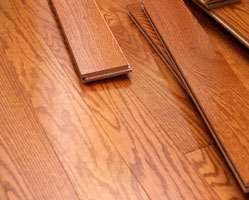
Long-term moisture measurement helps protect the owner’s investment after installation. Owners should still check moisture periodically, since almost every wood floor goes through some expansion and contraction as humidity changes with the seasons.
Heating, ventilation, and air-conditioning (HVAC) systems control indoor humidity, but outdoor RH can still affect indoor RH. When homes are heated in winter, indoor RH can drop, boards can shrink, and gaps can appear between them. These gaps usually close as the seasons change and moisture returns to the air. There’s no need to worry about these normal changes, but periodic moisture measurement helps keep a wood floor performing well for the long term.

Free Download – 4 Reasons Your Hardwood Flooring Failed
The Wood Moisture Meter Investment
Wagner Meters makes pinless wood moisture meters that accurately measure the MC of hardwoods, softwoods, and, with certain models, exotic species.
The Orion® 930 Dual Depth Wood Moisture Meter has settings for a wide range of species used in wood flooring and woodworking, including engineered flooring and bamboo.
At every stage of installation and throughout the life of the floor, a wood moisture meter helps you manage the wood’s MC.

As Sales Manager for Wagner Meters, Ron has more than 35 years of experience with instrumentation and measurement systems in different industries. In previous positions, he has served as Regional Sales Manager, Product and Projects Manager, and Sales Manager for manufacturers involved in measurement instrumentation.
Last updated on October 9th, 2026

 800-634-9961


We have just accepted delivery of 19 packs of Kempas solid wood flooring. This was a kerbside delivery and in order to carry this very heavy wood into the house we were obliged to open all but one of the packs carry them ourselves. There are no radiators or direct heat sources in the room where they are stored, but should they have remained in the packing until they are laid. ?
Hazel,
This is a very good site to visit, and get information regarding proper acclimation of solid wood flooring: http://www.oldewoodltd.com/what-to-know/resource-library/hardwood-floor-acclimation
Next, the National Wood Flooring Association (United States) has good information as well.
In short, the wood flooring needs to be properly stacked (see clip of photo, below), and acclimated; notice the spacing between layers to allow proper air flow and wood exposure to your proper environment. If you have any further questions, please feel free to contact us at 800-634-9961, or 541-582-0541.