



Carl Diebold Lumber Cuts Energy Costs
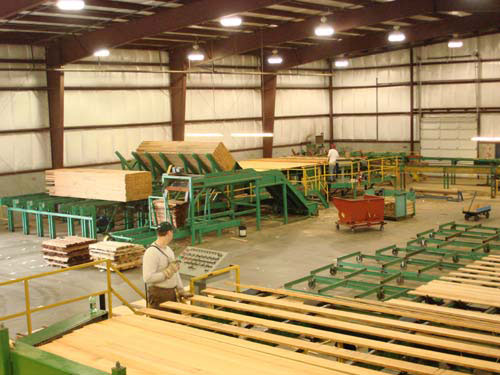 Founded in 1945 by Carl Diebold and located in Troutdale, Oregon, the Carl Diebold Lumber Company (CDLC) is a third-generation family business. It processes mostly clear and higher-grade lumber products that it doesn’t actually sell to customers.
“We don’t have any product sales,” says Dave Smith, plant manager. “All this wood we’re processing belongs to somebody else. Lumber wholesalers, for example, will buy rough green material from a sawmill and bring it to us. They specify what they want us to do with it.”
To meet its customers’ strict specifications, CDLC takes extra steps to make sure the upper-grade materials it processes are of the highest quality. One of those steps is using a computer-driven in-kiln moisture measurement system.
In 2010, TimberLine magazine featured CDLC and its then newly installed in-kiln moisture measurement system. In 2016, after six years of using the MC4000 in-kiln system, we checked in with CDLC to see if it was still living up to expectations.
In-Kiln Moisture Measurement
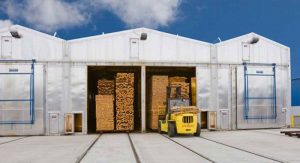
CDLC installed three dry kilns in 2005 to keep pace with production at a remanufacturing plant built in 1989. Smith says that even before deciding which kilns to install, they chose the MC4000 In-Kiln Moisture Measurement System from Wagner Meters.
“In order to produce high-quality products, knowing the moisture content (MC) throughout the drying process is very important. If you overdry the wood, you can destroy it,” Smith says.
“It’s also key that the material not be wet, that it be the right MC when it comes out of the kiln, otherwise it won’t mill properly and we won’t get a good, quality finish. Also, once the wood gets installed in its final use, if it’s too wet, it will start shrinking and cause problems.
“That’s why the MC4000 is so critical. For the past six years, it has provided us with consistently accurate information about the wood’s MC,” he adds.
Economics is another reason to monitor MC carefully.
“If you buy a 2×4 at your local big box store that’s full of knots, you’re talking about $500 to $600 per 1,000 board feet. Most of the materials we’re producing are clears and other high grades that range from $4,000 to $5,000 per 1,000 board feet. So we can’t afford to destroy any wood in the drying process because it gets very expensive.”
Smith says the MC4000 has also saved CDLC time, money, and energy by shortening drying schedules. Because operators can monitor drying in real time and adjust the schedule as the wood dries, a charge that used to take seven days can finish sooner.
“We can shorten that time to maybe five or six days. So we can take a day or two’s worth of energy consumption out of the equation, which is fairly high.
“We run a Hurst gas-powered boiler, so we have a lot of gas we’re pumping in there to heat the water to generate the steam. And then, kilns have large fans in them which consume a fair amount of electricity. So by shortening that time, we save time, energy, and money,” Smith explains.
Minimizes “Hot Checks”
The in-kiln moisture measurement system also minimizes “hot checks.” Instead of doing several manual checks during a charge, which means cooling down the kiln, operators do one check near the end of the drying schedule and a final one at the end.
“By having the in-kiln system, we don’t have to shut the kiln down several times, open it up, and lose all that heat. We rely on the Wagner to tell us when the wood reaches 10% to 12% MC. It’s very costly to bring the kilns back up to 180 degrees. By eliminating additional checks, we’re not losing that heat. This saves us energy,” he says.
CDLC processes mostly Douglas-fir, western red cedar, and occasionally hemlock. These species can be challenging to dry, especially western red cedar and, to a lesser degree, hemlock.
Cedar is a delicate species to dry. Smith says that if they dry it too aggressively, too hot and too fast, they’ll end up with cell collapse in the wood.
Because cedar is so sensitive to temperature changes, CDLC adjusts the schedule as the MC goes down.
“We can increase the kiln temperature by using the Wagner system because it tells us in real time where that moisture is. So we can make those adjustments sooner than later. Again, this will shorten the time in the kiln and lower our costs,” Smith says.
Computer Controlled
Each kiln has its own MC4000 measurement system, with one computer running all three. The Drystar Computer Control System from American Wood Dryers, which supplied the kilns, takes the information from the MC4000 and tells the kilns what to do: heat up or cool down, adjust the dry bulb or wet bulb, and adjust fan speed.
Two of the kilns are single-track kilns that hold about 60,000 board feet per charge. The third is a double-track kiln that holds about 140,000 board feet per charge.
The kilns dry about 1.4 million board feet a month, while the plant processes upward of 3.2 million board feet a month.
As most kiln drying operators will tell you, kiln drying is an art that takes skill and technical knowledge. But a reliable in-kiln moisture measurement system working with a good computer control system makes it much easier, while saving time, energy, and money.
CDLC’s kiln operators agree. Looking back over six years, they say their in-kiln system is still proving its worth.
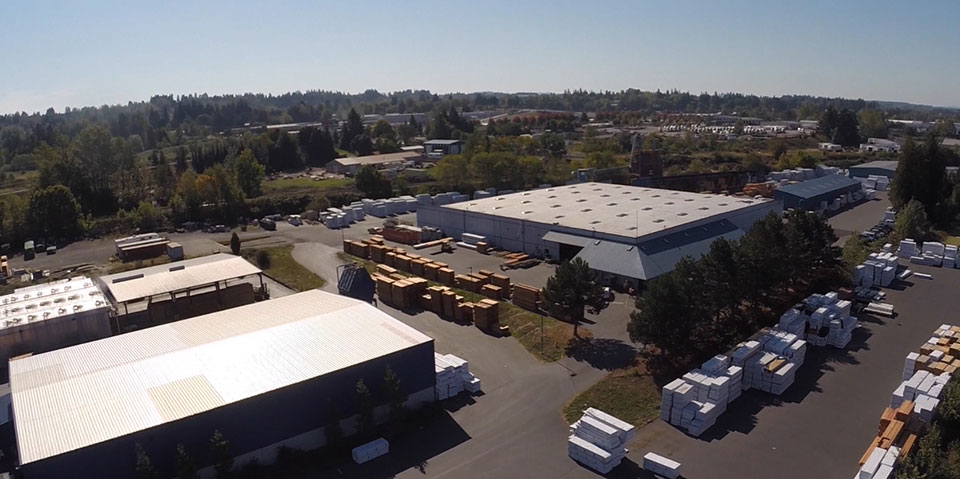
Carl Diebold Lumber Company saves time, energy, and money with the Wagner Meters MC4000 In-Kiln Moisture Measurement System.
Shop Industrial Wood Moisture Meters

Tony Morgan is a senior technician for Wagner Meters, where he serves on a team for product testing, development, and also customer service and training for moisture measurement products. Along with 19 years field experience for a number of electronics companies, Tony holds a B.A. in Management and his AAS in Electronics Technology.
Last updated on October 9th, 2026

 800-634-9961


