



Kiln Dried Wood – Why Moisture Readings are Important
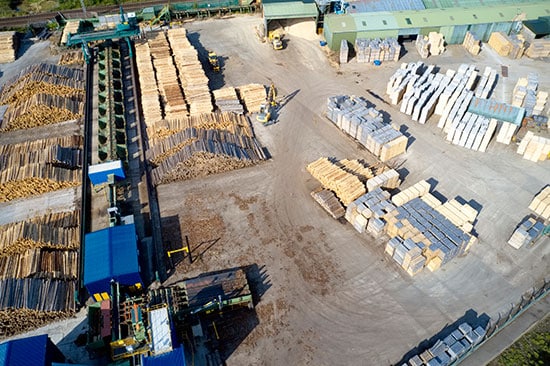 Freshly sawn lumber is “green,” meaning it hasn’t been dried. Green lumber is very wet, and once its moisture content (MC) drops below the fiber saturation point, it shrinks with every percent of moisture it loses and can warp, no matter how it’s dried.
- Kiln Drying Is Not Permanent
- Kiln Drying Your Own Wood
- Moisture Readings are Important
- Two Types of Moisture Meters
- How to Kiln Dry Wood
When lumber companies kiln dry their wood, they control the temperature and humidity carefully to avoid over-drying or under-drying. That lets the wood dry to the correct MC for its intended use, so it stays stable once it’s in service.
Under-dried wood keeps shrinking after it’s put to use, and over-dried wood swells as it picks up moisture. Either way, it can warp and won’t have the correct MC for its intended use.
Kiln-dried wood is dried to a specific MC range depending on its final use. According to Virginia Tech, lumber for interior uses, such as furniture, should be dried to 6% to 8% MC, lumber for exterior uses is usually dried to 12% to 15%, and softwood framing lumber is usually dried to 19%.
Kiln Drying Is Not Permanent
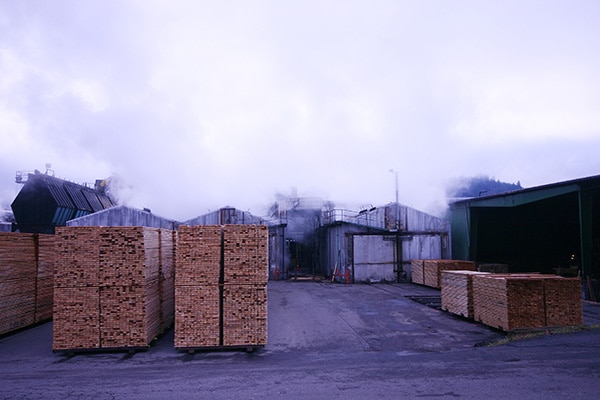 Some people mistakenly believe that kiln drying is permanent and that a pile of lumber stamped “certified kiln-dried” will always be good to use as is.
Wood is hygroscopic, which means it absorbs and releases moisture. The moisture might come from a direct source such as rain, from an adjacent material, or from humidity in the air.
That applies to any wood, including kiln-dried wood.
So when woodworkers buy kiln-dried wood, all they can be sure of is that the lumber went through a kiln. They have no assurance that it was dried properly without drying stresses, that it was dried to the MC they need, or that it hasn’t regained moisture since.
This last point is very important to understand. Once kiln-dried wood leaves the lumber company, its MC can change at any time: during shipping, during manufacturing, or while it’s stored in a woodworker’s garage or shed.
Kiln Drying Your Own Wood
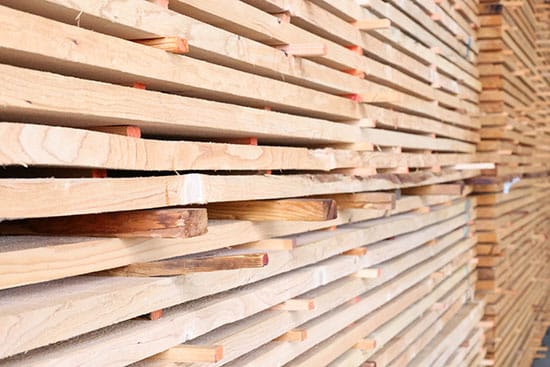 Kiln-dried lumber can be expensive, so some woodworkers dry their own wood, which also lets them control its final MC.
One option is to air dry green wood. But air drying can take several months, and in most places the humidity keeps air-dried lumber from reaching the low MC needed for interior use without the extra step of kiln drying.
Another option is a backyard solar kiln. Solar kilns are relatively inexpensive to build and easy to operate, and Virginia Tech’s design can dry a load of 1-inch lumber in about a month of moderately sunny weather.
Dr. Gene Wengert of The Wood Doctor’s Rx, LLC, a former extension wood products specialist at the University of Wisconsin-Madison, developed a popular solar kiln design while at Virginia Tech. In his words, “Solar kilns won’t dry wood too fast. It’s pretty much a ‘set it and forget it’ system.”
“It’s only near the end of the drying when you need to measure MC to determine if it’s time to stop the process and pull the wood out,” Dr. Wengert adds.
Moisture Readings are Important
When you’re first learning to dry lumber, especially lumber thicker than 1 inch, or drying a new species, monitor the MC daily to make sure the wood isn’t drying too fast.
Virginia Tech recommends doing this with sample boards: short pieces cut from the load that you weigh each day to calculate their MC. Compare each day’s moisture loss with the “safe drying rate” for that species, which is the maximum MC loss in one day. Electric moisture meters aren’t accurate above about 30% MC, so the sample board method is the way to go early in drying. Once the wood drops below 30% MC, a moisture meter is a fast way to check it.
Safe drying rates for 1- and 2-inch hardwood lumber are listed in tables, such as the one in Virginia Tech’s solar kiln publication. Exceeding the safe rate can cause cracks, checks, and other defects. The risk is highest early in drying, and once lumber is below about 22% MC, the risk of new cracks and splits is low. If the wood is drying too fast, you can cover part of the kiln’s solar collector to slow it down.
Dr. Wengert recommends choosing sample boards at the start that will dry slowest, such as boards that started out wetter than the rest of the load, were cut more recently, or are a little thicker.
“If you check the sample pieces and they’re too wet, you’re going to continue drying,” says Dr. Wengert. “You want to make sure your sample pieces are dry enough before you stop drying. It doesn’t really matter if half the load is ready to be pulled out.
“So don’t pull the load based on the average. We usually pull the load based on the wettest pieces. The wettest has to be dry enough,” he says.
Two Types of Moisture Meters
Woodworkers have a choice when it comes to selecting a moisture meter. They can choose a pin meter or a pinless meter, and each has advantages and disadvantages.
One advantage of pin meters (only those that use longer pins with insulated shafts) is that wood can be tested for moisture at different depths. The main disadvantages are the small area tested with each insertion, the need to correct readings for wood temperature, and the holes the pins leave in the wood. Pins can also break or give inaccurate readings when they’re inserted improperly.
Pinless meters, on the other hand, don’t penetrate the wood’s surface, so they won’t damage the wood. They also let you scan many board feet of wood quickly.
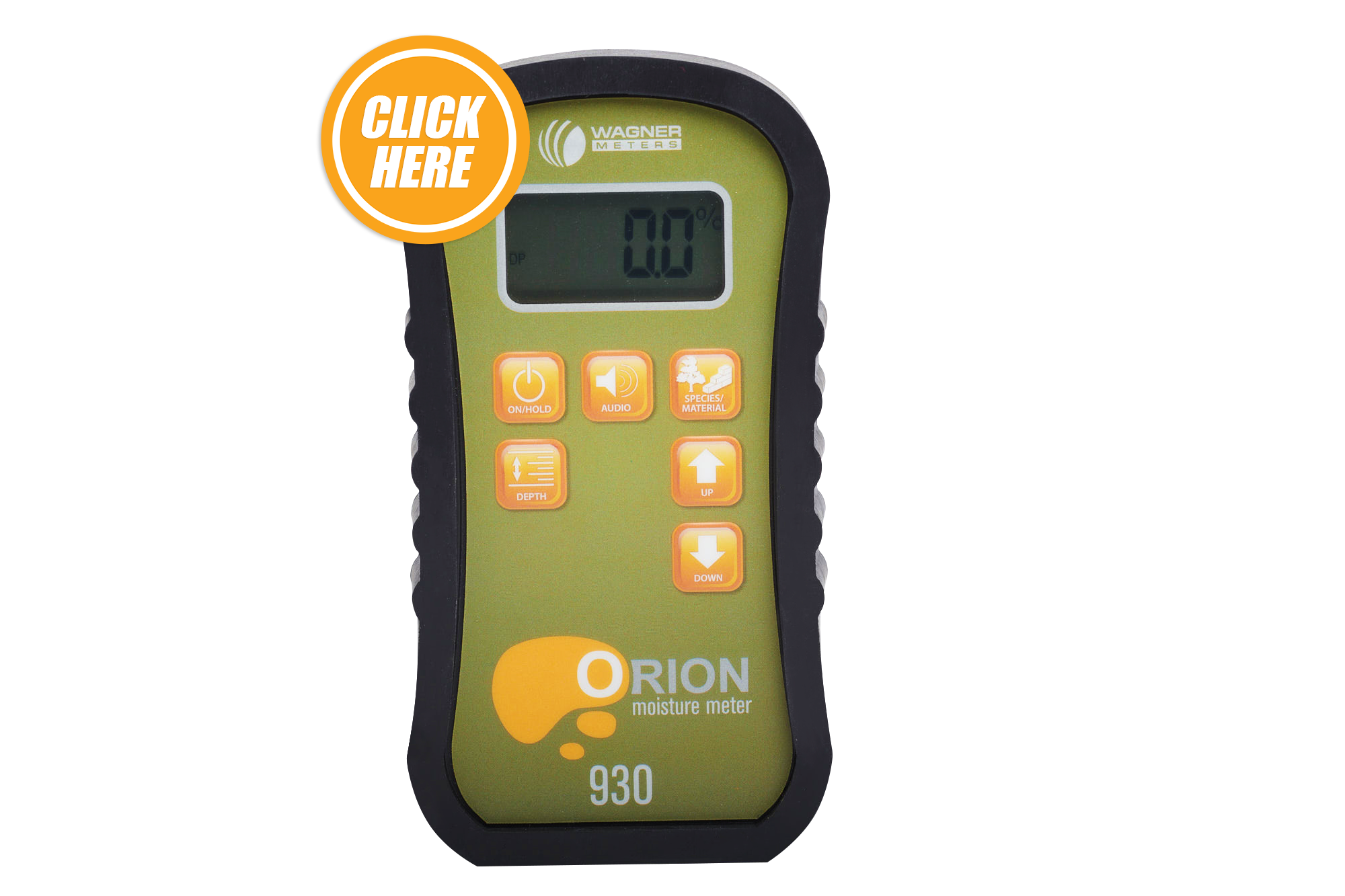
Pinless meters read an average MC over a set depth, typically up to about ¾ inch, and over a larger area than pin meters. They do need to be held flat against the wood with firm pressure to give a correct reading.
Wagner Meters’ Orion® pinless meters use IntelliSense™ technology, which helps keep surface moisture from skewing readings.
The Orion 930, 940, and 950 have two depth modes: a shallow mode that reads ¼ inch deep and a deep mode that reads ¾ inch deep.
Orion meters have settings for a wide range of species, from common softwoods and hardwoods to tropical woods.
How to Kiln Dry Wood
Several resources provide plans for building a backyard kiln and go into more detail about kiln operation. Here are some to consider:
First is the design mentioned above, developed by Dr. Wengert. It’s often called the “Virginia Tech solar kiln” because he developed it while working at Virginia Tech, and many other solar kilns are based on it.
Dr. Brian Bond, Professor and Extension Specialist at Virginia Tech, has since published an updated version adapted from Dr. Wengert’s work, Design and Operation of a Solar-Heated Dry Kiln. It’s free and covers a kiln that holds 750 to 1,000 board feet, with a materials list, operating instructions, and safe drying rates for common hardwoods.
Virginia Tech has also offered hands-on workshops on drying lumber in a solar kiln in Blacksburg, Va. Check with the university for current dates.

Free Download – Is a Pin or Pinless Moisture Meter Best For You?
WOOD magazine also published an article on building a solar kiln, “WOOD Magazine Builds a Solar Kiln” (PDF).
Woodworkers can choose from several types of kilns, but the resources above are for kilns that are inexpensive to build and simple to operate.
Summary
For hobbyists and professional woodworkers who want to avoid the cost of commercially kiln-dried lumber, a homemade solar kiln may be the best option.
Solar kilns are relatively inexpensive to build and easy to operate, and beyond the electricity to run the fans, they cost little to run.
To make sure a solar kiln doesn’t dry wood too fast, which can cause costly defects, track the MC regularly with sample boards and a moisture meter. That helps keep the finished wood from cracking, warping, or splitting.
Learn more about kiln drying and what happens when it goes wrong.

Tony Morgan is a senior technician for Wagner Meters, where he serves on a team for product testing, development, and also customer service and training for moisture measurement products. Along with 19 years field experience for a number of electronics companies, Tony holds a B.A. in Management and his AAS in Electronics Technology.
Last updated on October 8th, 2026

 800-634-9961


I would like to build a small kiln for drying firewood. Approx 2 cords at a time. Have natural gas and electric available on site.
I own and operate a composite molding company and we have large Despatch Gas Curing oven that we would like to utilize for drying hardwoods. Are you familiar with using this type of oven for drying wood?
It is a gas-fired, closed air circulated system that can run multiple cure cycles up to 550 deg F.
Thank you,
Greg Brookes
Sherwood RTM Corp
Louisville, Ohio
Greg,
I am unfamiliar with that technology being used for drying of hardwoods. Certainly, the temperatures for drying hardwoods need to be much lower than that. 180°F is usually the maximum, and temperatures and general conditions need to be adjusted as the lumber is going through a typical hardwood drying schedule, such schedules generally being different depending on the species and thickness.
If you are going to attempt to Kiln Dry any Wood. You might be better off using a Vacuum Pump like those that are sold to repair Refrigeration Units on vehicles. If your Wood is placed within a Chamber that has been evacuated of the air surrounding us and heated. The Temperature required depending upon your Elevation might only be 90 Degrees. Where I live, I only have to Heat the Wood to 98 Degrees Fahrenheit for a period of 3 Days to achieve a 10% Relative Moisture Content.
Thank you for your input, Ronald.
I’m preparing my own business with a mobil sawmill and kiln. Do I need to get an “approval stamp” for my lumber or does it just matter where the lumber is being used? For example on framing for a house or framing for a shed. Or shelves or other furniture pieces or moldings in a house?
Josh:
You should contact your county inspector to determine that information, especially regarding structural framing members.
Regarding the interior wood pieces such as moulding or furniture, there should never be any necessary approvals. People make furniture all the time for their own use.
Before I buy the plans I am wondering what’s the ballpark number to build a dryer like the one above?
I live in florida and have some Pecan wood I want to dry out. I have a storage shed no electricity, no a/c, gets real warm. The pieces are 6.5 long15 inches wide, Three are6 quarter and two are 8. Currently at 35% according to surface MG. Will this type of setup work?
Richard, Our Wagner WoodH2O app will help you determine what the wood will equalize to given certain temperature and humidity values. This app is free and is available for iPhone and Android. Also, a good moisture meter will help you monitor the moisture content. I recommend our MMC205 or MMC210 found here: https://www.wagnermeters.com/moisture-meters/