


Understanding Wood Moisture Content
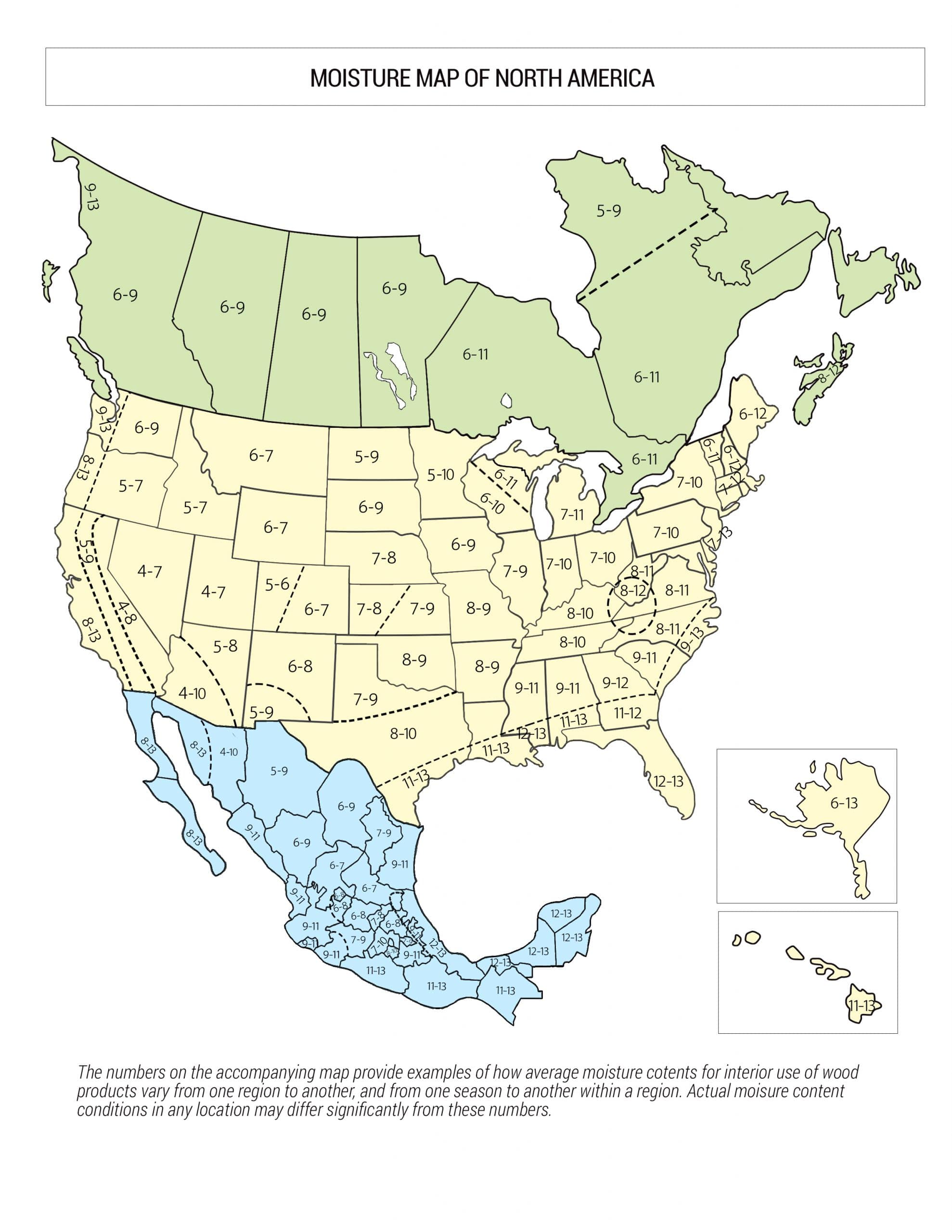 As a hygroscopic material, wood interacts with any moisture it comes in contact with. There’s no avoiding this natural process, meaning that any piece of wood, of any type, will behave differently depending on the moisture content within it and the amount of moisture in the air around it.
That’s why, when working with wood, the quality and durability of a finished product often depend on how well the moisture content is monitored and managed from start to finish.
So let’s break down exactly how moisture content affects the wood you’re working with, and what to do about it.
Let’s look at the science first.
Equilibrium Moisture Content (EMC)
Everything you need to know about wood and moisture rests on one functional principle: The moisture content (MC) in wood will always move toward equilibrium with the ambient moisture in its end-use environment. In other words, wood’s natural moisture levels must reach equilibrium with its external surroundings before construction or installation begins.
You can probably guess why: Wood swells when it absorbs moisture from the air and shrinks when it releases moisture. And in any finished product, you don’t want to risk the potential warping from continued shrinking or swelling.
The goal, then, is for the wood to reach Equilibrium Moisture Content (EMC), which occurs when the MC inside the wood reaches a balance with the relative humidity (RH) and temperature of the wood’s surrounding environment. You can see how this balance is crucial, since wood continues to absorb and release moisture as the RH changes over time.
Wood strength and performance, then, can be compromised by any MC imbalance. This is why lumber producers invest so much money in their kiln drying equipment and processes — to ensure quality control by drying the lumber to a specified target MC to ensure that the wood’s EMC is reached before shipping.
Builders and homeowners need to pay the same respect to wood’s need to acclimate to its surroundings upon delivery to its permanent home. Unfortunately, such respect is too often neglected in the rush of a busy schedule.
How Wood Moisture Meters Can Help
 Moisture meters specifically designed for wood can provide installers, woodworkers, contractors, inspectors, and homeowners the opportunity to easily and accurately monitor the wood’s MC.
At Wagner Meters, we have a variety of wood moisture meters for all levels of woodworkers and wood flooring experts. Orion® Pinless Moisture meters provide an easy, user-friendly way to measure moisture content in all types of wood, including hardwoods, softwoods, and exotic tropical wood species.
Woodworkers can utilize moisture meters to nurture those cherished wood projects to moisture equilibrium.
Builders and installers can verify that wood has sufficiently acclimated and reached EMC before getting started.
Inspectors can detect moisture variations in wood and other building materials as well.
Moisture meters have evolved with the advances in technology over the years so that users can measure and observe a material’s MC quickly, easily, and consistently.
Ironically, the one wild card in the deck is human error or oversight.
Wood manufacturers invest millions in MC measurement and management during the wood production process: kilns, in-line MC systems, and handheld MC spot-checks by the hundreds. Industry professionals understand that quality control begins with the arrival of green timber at the mill.

Free Download – Is a Pin or Pinless Moisture Meter Best For You?
However, too many builders and consumers presume that the quality control imperative is permanently assured by the lumber kiln drying process. Wrong.
Wood also needs time to acclimate to its new environment after arriving on-site. Before installation, “permanent settlement” time is a prime time to measure the MC with wood moisture meters.
A reliable wood moisture meter provides crucial evidence installers can use to ensure that the wood product has achieved its EMC state before installation began. Only with the confirmation of the wood reaching its EMC can users be assured of stable, long-lasting product strength and performance.
In the Long Run
Changes in temperature and humidity can happen throughout the year in many parts of the world. But if a wood product was never properly acclimated, it’s likely to be much more sensitive to these kinds of weather fluctuations.
Once the wood is safely installed, homeowners and hobbyists alike can use a wood moisture meter to continuously monitor the wood product’s MC for optimum long-term health.
As long as moisture is with us, it benefits to measure it. Wood performance will always depend upon the numeric information provided by wood moisture meters.

Troy Edwards is Technical Service Supervisor for Wagner Meters, Inc., where he oversees manufacturing, quality control and IT service for their electronic measurement products for the building and construction industry. Troy holds an AAS in Electronics Technology and has over 20 years’ experience in various electronic manufacturing and production positions.
Last updated on December 11th, 2025

 800-634-9961


