


Top 10 Concrete Moisture Testing Myths
Concrete flooring installers know the struggle: moisture issues can undo a good installation. You prepped the subfloor, used the right adhesive, and followed manufacturer guidelines, and weeks later there’s bubbling, warping, or adhesive failure. Often the cause is a piece of conventional wisdom about moisture testing that turns out to be wrong.
Old rules don’t always apply to modern flooring materials. Changes in concrete formulations, adhesives, and environmental conditions mean installers need to rethink their approach.
- If the concrete surface is dry, the slab is dry
- All floor products have similar moisture tolerances
- The concrete is old, so it has to be dry
- The slab is not on grade, so there’s no need to do moisture testing
- Surface testing gives more accurate readings of the moisture level
- Drying time can be estimated accurately
- All RH tests are the same
- Test hole depth is approximate
- Concrete additives don’t impact drying time
- Dust on a job site doesn’t impact RH testing
Your Guide to Moisture Testing for Concrete Slabs
ASTM F2170 covers the use of in situ probes for determining the moisture condition of a concrete slab at the point it will be sealed or overlaid by flooring material.
These probes give a relative humidity reading at 40% of the slab’s thickness when drying from one side, or at 20% for slabs drying from both sides. You’ll need at least three tests for the first 1,000 square feet, and one more test for every additional 1,000 square feet.
Want more detail on moisture tests for concrete floors? Read our in-depth article.
Concrete Moisture Testing Myths
Myth #1: If the concrete surface is dry, the slab is dry

Repeated studies have shown that the surface of a slab is not an accurate indicator of overall moisture levels. Air movement, ambient temperature and relative humidity, troweling technique, and other variables all affect the drying rate, so conditions at the surface don’t represent the moisture within the slab. Any method that tests only the surface should be treated with suspicion.
As moisture moves through the slab and evaporates at the surface, a moisture gradient forms, so the moisture condition deeper in the slab can be very different from the surface. The level that matters is the slab’s point of equilibrium: the moisture level that remains after installation, once the gradient evens out. That’s what the installed flooring will see for the life of the floor.
In situ RH testing is the way to determine that condition. A sensor placed inside the slab, at the correct depth, shows the moisture condition the flooring will face once the slab is sealed.
Myth #2: All floor products have similar moisture tolerances
At one time, flooring adhesives and materials were more consistent in their moisture tolerances, because most had a petroleum-derived base. As formulations changed for different applications, it became more important that slabs under flooring installations were dry, to prevent moisture-related problems later.

The industry has focused on lowering VOCs in building products, adhesives, and flooring. As a result, tolerances to prolonged and elevated moisture vary considerably from one adhesive to the next.
Perform accurate RH testing to determine the current slab moisture condition, confirm the specified product is compatible with it, and choose a product suited to the conditions you have.
For manufacturers that specify relative humidity tolerances for their products, see RHSpec.com.
Myth #3: The concrete is old, so it has to be dry
Even when a slab has been in service for years, moisture levels inside it can be high, for reasons including recent flooding, leaking pipes, and a rising water table. It isn’t unusual for an old flooring system to be removed and the newly installed flooring to show moisture-related problems soon after.
Products used decades ago were also inherently more moisture-resistant than many products sold today. The move toward lower-VOC products means moisture tolerances in adhesives, sealants, and flooring need more attention. An old slab may be holding moisture that couldn’t escape through the older, more moisture-resistant flooring, and that moisture will now meet a less tolerant product.
An older slab can also face moisture intrusion from an unidentified source, such as a compromised vapor retarder or an appliance or plumbing leak, that has raised the slab’s moisture without yet reaching failure levels for the old flooring.
Never assume an older slab is dry enough. RH testing before installing any new flooring system is the only way to know. The Rapid RH® L6 system seals a sensor in each test hole for immediate readings, which keeps ASTM-compliant testing straightforward.
Myth #4: The slab is not on grade, so there’s no need to do moisture testing
All concrete is affected by ambient RH and temperature, so all concrete is susceptible to moisture-related problems and should be tested before flooring installation begins.
There are two significant differences for slabs not on grade:
- Slabs on grade, or on pan decking, have only one surface through which moisture can leave. Slabs not on grade have two, which also means two surfaces that can absorb moisture from a humid environment or an external source. Whether testing is needed has little to do with the format of the pour; which test depth to use has everything to do with it.
- ASTM F2170 sets 40% as the correct test hole depth for slabs poured on grade or in pan decking, where moisture leaves through one surface. For slabs with two surfaces exposed to ambient conditions, the correct depth is 20% of the slab’s thickness.
In situ RH testing for concrete at the appropriate depth is what provides accurate, actionable results.
Myth #5: Surface testing gives more accurate readings of the moisture level

Any test method that reports surface moisture conditions risks producing a false reading, which is why many authorities on concrete moisture testing consider surface testing unreliable.
Two test methods report only at the surface:
- The calcium chloride test (MVER) seals a desiccant under an impermeable cover and calculates a rate by weighing the material after a set time. The theory is that the desiccant absorbs moisture emitting from the slab, and the weight gain expresses a ratio of the remaining moisture. The test lacks a strong scientific basis and has been specifically disallowed for some concrete types.
- Concrete moisture meters send an electrical signal into the concrete and measure resistance as an indicator of moisture. They’re useful as survey tools, but they typically read to about ¾” and can be affected by rebar, certain aggregates, and other elements. ASTM F2659 positions concrete moisture meters as a means of comparative measurement only.
Moisture levels in a drying slab tend to be higher toward the bottom, and equilibrate through the slab once it’s sealed by a floor covering. A test that doesn’t measure below the surface can’t show what those levels will become after the flooring is installed.
Myth #6: Drying time can be estimated accurately
The industry rule of thumb is one month of drying time per inch of slab depth. It gives a rough expectation, and it overlooks the variables that determine how long a particular slab actually needs.
For concrete to dry, most of the excess moisture has to reach the surface and evaporate. That moisture travels through capillaries that form as water combines with cement, aggregate, and admixtures. The size and number of those pathways depend on the mix, and the amount of water in the mix determines how much moisture has to leave in the first place. If the pathways are blocked or poorly distributed, drying time stretches out.
Outside factors matter too. Aggressive troweling or certain curing compounds can trap moisture below the surface, and ambient temperature, humidity, and airflow all affect the schedule.
Given how many variables feed into it, guessing is a poor bet when in situ RH testing measures the slab’s actual condition. Watch: what if your concrete slab won’t dry?
Myth #7: All RH tests are the same

RH test methods share a basis in research showing that measurement below the slab surface is more accurate for determining concrete moisture conditions. How each product is designed, though, affects testing time, accuracy, and performance.
Most RH test methods use removable sensors that must be inserted into the test hole and given time to acclimate for every reading, with calibration checked no more than 30 days before each use. That makes testing slow, and it invites leapfrogging: moving sensors from hole to hole without allowing enough time to equilibrate in each one.
The Rapid RH L6 uses Smart Sensors that install directly into the slab for a one-time acclimation, with readings taken by the Total Reader® or DataGrabber®. Each Smart Sensor ships with a NIST-traceable certificate of calibration. Readings can be collected with the DataMaster™ L6 app.
Myth #8: Test hole depth is approximate
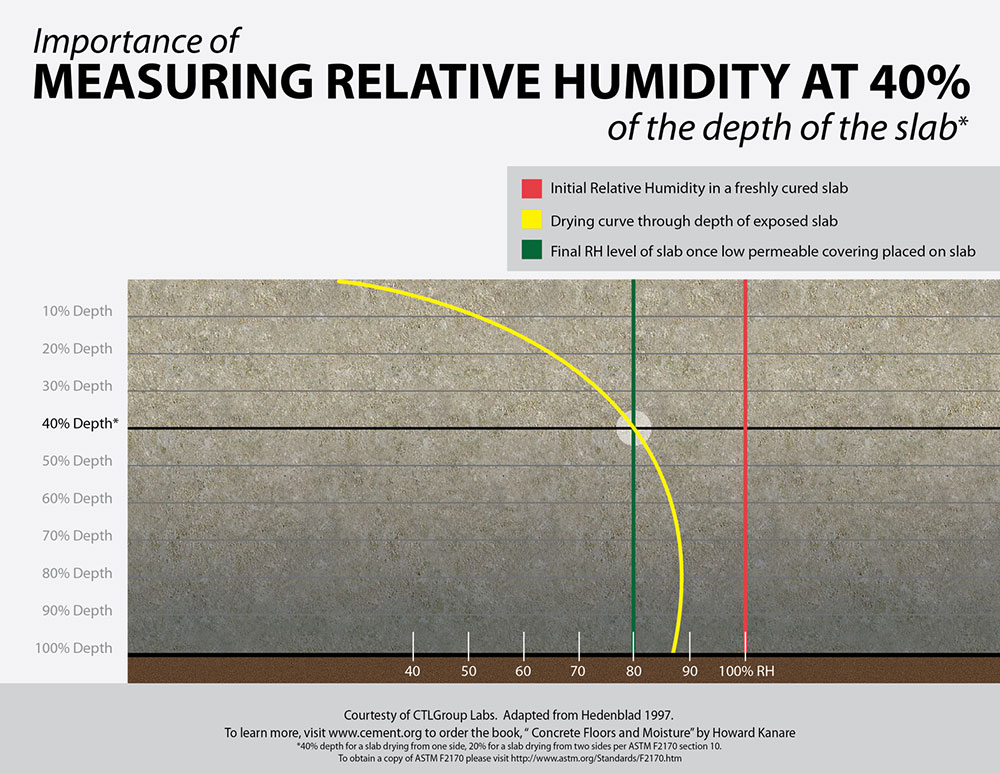
Click the image for a larger view
The point of in situ RH testing is to determine the moisture condition of a slab once the floor covering is applied, because a condition that’s too high puts the whole floor system at risk. An estimated $2.4 billion a year is spent repairing moisture-related flooring failures.
Moisture levels inside an unsealed slab are higher toward the bottom and equilibrate through the slab once it’s sealed. Until then, the depth of the test hole determines what the reading means, and measurements at different depths give significantly different results.
That’s why ASTM F2170 specifies depth rather than leaving it to judgment. For slabs drying from one side, such as slabs on grade or on pan decking, 40% of the slab’s thickness is the correct depth. For slabs drying from two sides, it’s 20%. Determining the slab’s thickness accurately is part of getting this right.
Myth #9: Concrete additives don’t impact drying time
Some admixtures are meant to affect drying time. Superplasticizers such as lignosulfonate or polymer compounds are designed to reduce the water needed in the mix, so drying times can be shorter.
Other additives range from reducing shrinkage or damp-proofing to extending workability and adding pigment. Each class changes the properties of the batch chemically, and can affect the actual drying time of the slab. Some admixtures also affect certain moisture test methods, which is another argument for RH testing.
Myth #10: Dust on a job site doesn’t impact RH testing
Dust and grit are close to inevitable around concrete work, and they affect the accuracy of RH testing when residue from drilling stays in the test hole. Debris compromises the air volume around the sensor, which is what the sensor is reading.
Clean each hole after drilling. RH test kits, including Wagner Meters kits, come with a wire brush and a vacuum attachment for this. Between readings, use flush-mount protective caps, which identify each hole and seal it against site contaminants.
Bonus Question: Can Moisture Come Up Through Concrete?
Concrete acts like a sponge, absorbing moisture from below and drawing it up through capillaries. That moisture causes flooring problems, and it can lead to mold and mildew growth.
Watch: 5 common sources of moisture in old concrete
Document Your Readings
Readings you don’t record can’t help you later. Documentation is your evidence: if something happens to the floor, the records show what the slab’s condition was and when, which helps you decide what to do next. They also demonstrate that you followed the procedure, which matters if a failure turns into a dispute.
Some systems record and store readings for you. The DataMaster™ L6 app captures Smart Sensor readings and produces ASTM F2170 reports from them.

Free Download – 4 Reasons Why Your Concrete Is Taking Forever to Dry
Additional information on concrete moisture testing: Rapid RH Test
Download the Rapid RH ASTM F2170 Checklist

Jason has 20+ years’ experience in sales and sales management in a spectrum of industries and has successfully launched a variety of products to the market, including the original Rapid RH® concrete moisture tests. He currently works with Wagner Meters as our Rapid RH® product sales manager.
Last updated on September 16th, 2026

 800-634-9961


It stood out to me when you mentioned that a moisture gradient can form in concrete slabs. As far as I know, many roadways around the world are made out of concrete because of its availability. It seems like making roadways moisture-resistant would be the best way to prevent damage from occurring.
I am remodeling my basement. The contractor put plywood directly on the concrete in some areas for sub flooring and joints in other areas because the floor was not level. Is this a problem? I’m on a hill in San Francisco but if I cover he concrete overnight with plastic, I see some moisture. Thanks!
Ed:
Thanks for the questions. I would expect that it would be best to have some form of a vapor barrier between the concrete and the wood plywood and/or dimensional lumber. Your local building codes may specify more directly. Good luck.
Very interesting info. I’m planning on installing a solid wood floor on first floor level concrete in a closet. I want to glue directly to the concrete and I think I’m aware of all the moisture considerations. My moisture reader device was showing 45% for the concrete yesterday. Today it’s 99.9%. This is when I lay it down on the concrete and use as directed. Can the reading vary that much? The slab has been in place for 20 years and we have no leaks or issues.
What level of moisture is safe to install the floor on? I’ve ready about some sort of equilibrium between the flooring and the concrete. The flooring as it lies in the same closet is reading less than 10%. They’ll never be ‘equal’ will they?
Maybe a dumb question but if the glue available contains moisture barrier, why isn’t it sufficient to protect against the moisture coming up through the concrete? If it’s only supposed to help, what is the acceptable moisture content in the concrete whereby the glue is enough protection?
Thanks for the question. Unfortunately, when you speak of 45% and 99.9%, giving no context of what the % designates, it is hard for me to answer this question. If you are going to glue a solid wood to concrete, the baseline moisture condition should be 75% or less relative humidity when measure with a device installed into the concrete. The wood, prior to installation, should be acclimated and equilibrated to the condition on the air in the environment where it is being installed. This is done by taking a relative humidity and temperature of the air and calculating the moisture content of environment. We have an app called Wood H2O. Once the wood has reached this number and the concrete is below 75%, in most cases you are ok to install. Always check with the manufacturer’s.
You may be correct with the glue, but you need to check with the various manufacturer’s about acceptable levels because they can be very different. Good luck.
Outside of our front door is an alcove which is about the size of 4×6. It has a concrete floor and 4 concrete steps allowing entrance into the house. The concrete is butted by blacktop from our driveway. The is about an inch gap between the concrete and blacktop that is dirt. Our home is over 50 years old. For the past month we have noticed that the concrete is wet, more moisture, like it was wet and now drying, it covers all of the back to the house and a little ways up the foundation, plus on the side of the stairs, about one step up. The strange thin is it does not appear on all the concrete, there is a pattern from the back which runs to TBE driveway, but only up the middle. We are baffled because it dries then it happens again. We have no idea who to call to get this checked. There are no visible lipid leaks in our home. We do have well water. Can you advise?
Brenda:
Thanks for the questions. I wish I could be more help, but I think I would start with calling out a leak detection company and then if that checks out some type of geotechnical engineer for evaluation. Good luck.
Wow this is such great content on concrete! I just had a new slab put in to extend my driveway to the side. It went smoothly with the contractor I hired and they were professional and nice. The guy I talked to told me the “industry standard” of one month before we could drive on it. He even told me that the fall season is the best season to do concrete since the cooler weather allows for more even drying. Not sure if that’s accurate based on your article, but it made me curious. You mentioned that overall temperature and RH do impact drying time, but does concrete harden better in cooler weather?
John:
Thanks for the question(s). I would agree that his “one month” standard would be accurate, at least for heavier loads. He is talking about the hardening of the concrete, not necessarily the drying. At 30 days, the concrete has reached most of its compressive strength. Regarding the cooler temperatures, when you have higher temperatures, the concrete will tend to dry quicker on the surface, and having that inconsistent heat/temperature isn’t necessarily the best for cracking, curling and other surface conditions of the slab.
Greetings,
This is a great wealth of information and I thank you for posting the myths and questions. I am stumped trying to figure out how to help my elderly mother with her condo build on a slab in a planned urban development. Lots of homes are being thrown up in no time flat. I am told that there is a vapor barrier below the slab but not one under the garage. Mom moved into the condo in mid June of ’17, the unit was brand new. It was very cold during a hot summer, that was appealing to her that she wouldn’t have to run up the electric bill with the AC. By mid September ’17, her furniture and belongings exploded into very heavy low lying mold. The builder cleaned the unit but said he did everything correctly and denied any need to test the slab. He said it was impossible to be the cause. I hired engineers to test the slab in 4 location throughout using your RH Rapid Test sensors and pen. Our pen read HI for all locations. It has continued to give those readings throughout the 2 years the sensors are valid. An engineer recorded the results. Today, the sensors still give me readings (we purchased the reader pen).
2 commercial dehumidification units were installed in the 1600sf unit. Sensors in every room with the exception of the open concept kitchen/living area. 2 sensors could only be installed in this location and it is clustered on one side of an open large area. In the middle of the room, a good distance away from the closest sensor, we saw green’ish mold coming up from a seam in the floating vinyl floor. Since we can’t put a sensor in the middle of the room for appearance purposes, could this slab be so saturated that plastic floors would mold? My Mom’s health is being affected. Her eyes are bothering her again (noticed the eye problem before the mold appeared). Is there any way to dry this floor or is this place a total loss without drastically dry humidity settings on the commercial dehumidification systems?
We considered a leak but requested water bills for similar buildings with similar occupancy. The water usage is similar enough not to spark further interest in pursuing that lead.
Do you have any ideas that might help me? I’m prepared for bad news so don’t hold back. I just want to know what our options are at this point. Many thanks Jason!
You made a good point that plumbing leaks can cause some moisture problems for a concrete slab. Perhaps I should first map out the pipes under my garden before decided where to build a new concrete patio. Getting the patio to last will definitely make my house look a lot more attractive and probably raise its value significantly too.
Hi Jason,
I was reviewing a clients basement water issues and ran across your article, just sending a quick thank you for writing it, definitely a big help, thanks and stay safe
Hello!
Thank you for this very informative article. I was curious what you think about climate and how it effects the cement material through-out seasons ranging from 100 degrees during the summer to below 32 degrees during the summer.
SIncerely,
Stefanie
Stefanie:
I will be honest and say I have little experience on this specific topic, but over the years many batch plant facilities and manufacturers have come up with very effective ways of either increasing or decreasing the hydration process based on conditions such as the extremes you outline.
We install epoxy coatings and have run into problems with moisture when a slab has had rain on the slab and we want to coat it. The RH meters we have tried seem to have a hard time reading surface moisture. They usually give us an acceptable reading for the concrete slab even when there is still visible moisture. We will usually fall back to the plastic film test in this scenario however we are trying to come up with a more accurate and more importantly a faster way of measuring this surface moisture. Do you have any suggestions?
Brandon:
Thanks for the comment. For the long term viability of an interior finished floor, RH is the most accurate concrete testing method out there. In your specific application, you might want to take a look at a topical surface meter like the C555. Just keep in mind that this device, like others of the same type, are not really intended to make installation decisions, but to find suspect areas of surface moisture. With our C555 the concrete needs to also be very smooth to get the best results. Good luck.
Centennial, Colorado (very dry climate) I have 10,000 Sq. Ft. new construction. The concrete floor was poured in February. Our flooring company is ready to install flooring of 4 different types: Artificial Turf, Rubber, Vinyl, Synthetic Wood. The installer wants to do concrete moisture tests (drill 12 holes in the concrete at $80 per hole. This is new to me. Is this legitimate?
Kevin:
Thanks for the question. This is more than legitimate (and fairly priced) and you should thank this installer for looking out after your best interests, enabling him to help ensure he can install a product with a warranty. All manufacturers of flooring/adhesive/coating products require moisture testing to ensure a lasting installation. Let me know if you have any additional questions.
I live the Birmingham, Alabama. I have had carpet on a concrete floor for over thirty years and no problems. I recently had manufactured woods installed. The floor started bulking within three weeks. Part of the house is underground. The Company installing the floor did no testing. They are not taking any responsibility. I bought a meter. The humidity levels near the underground area are in the 90 percent range. No water is visible and no orders have ever been detected. The floor is partially removed. Shouldn’t the flooring company have measured the levels of humidity ? What next?
Nancy:
Thanks for the question and sorry for the issues. You would have hoped that testing would have been done so proper actions could have been taken, if necessary, prior to installing the new floor. With carpet, since it is breathable, you may have had a moisture issue in the concrete the entire time, but it never affected the carpet. Now that something has been installed that is less breathable, the problem is showing up. You could probably bring in a flooring inspector (https://www.nicfi.org/ ) and try to determine fault and then seek some type of remedy. On the other hand, you could seek out another reputable flooring installer and have them do the job correctly, armed with the new knowledge you have learned. Not sure either is a great option, but I hope this helps.
We are trying to replace an existing laminate wood type floor on a slab, have been drying out with dehumidifier and fans for 3 weeks and he just checked levels and are still at 4. Can we seal with those levels and then lay new flooring down?
Judy:
Thanks for the question. Unfortunately, I am not sure I am familiar with a scale for moisture in concrete that measures 4. I would check with the laminate flooring manufacturer and get their recommendations for your situation. Good luck.
Hi Jason wanted to get your opinion on a situation we have experienced, our house is a couple years old built by hey high end commercial Builder. We live in North Florida and had new flooring installed in January during weather in the 70s. The flooring was manufactured to order it is engineered hardwood. The flooring was installed within a week to two weeks of delivery from manufacturer. prior to installation we had all ceramic tile floors that was removed by the ride on machine method. A dritac moisture barrier glue was also used in the installation process. After a few weeks of the installation we started to notice there was some peeking of the ends of the long part of the planks. They are not really visible in certain lighting although when there is a glare coming from some of the windows and sliders you can see them throughout the floor. Also would like to add that the dining room and office had a cheaper hand-scraped hardwood that was installed when the house was built we did not notice any problems with this although it has a dimmer lighting and also being hand-scraped we were not able to detect if there were any issues with that flooring. Do you have any ideas why this would be happening and could this be an issue with the manufacturing process. Also will a tramex cmex surface moisture meter give us any clues.
Please help
And thanks, your expertise is is appreciated
Roxann:
Thanks for the question. This could be any number of issues, probably all related to moisture in some way. How was the wood acclimated? What were the moisture readings of the wood prior to the install? Based on the installed environment, what was the target moisture % of the wood? What were the moisture readings of the concrete prior to install? Have any conditions in the house changed after install? I would recommend that you look on this website http://www.nwfa.org and find a certified inspector to come out and evaluate the issue. Good luck.
Just removed vinyl plank without moisture barrier or underlayment product. moisture was present with a few areas of mildew. Immediately treated concrete with a bleach water solution by pump sprayer
I intend on laying rolls of moisture barrier underlayment that will be taped together, then installing a better vinyl plank product. I am assuming that water may do the same thing under the vapor barrier. I am thinking that I might want to apply a concrete sealer to trap water below the surface before the underlayment. Do I need to worry about this?
Bret:
Thanks for the question. This microbial growth issue is one of those issues that, in my opinion, will start to become more prevalent with the increased usage of “loose lay”, products. I believe you should be thinking about this and try to be proactive. Good luck.
Jason
We installed carpet tiles on old concrete floor. We used a sealer glue to install the carpet, but in one spot the water comes back thru the concrete. Can you tell why this keeps happening.
Chris:
Thanks for the comment. Based on the very limited information you have provided I would question whether there is an intact vapor retarder under the slab and the center happens to be the path of least resistance for the moisture to escape from the soil. The one way to make this determination is to do a core sample in that center area.
Thanks,
Jason
Dear Jason.
Thanks for your article.. It was very helpful.
I have a small query.
If I have to do epoxy floor coating on concrete structures, how much should be the ideal moisture content (%wise) or RH to start the work?
Means what is the acceptable value of RH for starting the epoxy floor coating.
Sushmit:
Thanks for the question. It depends on the specific coating, but many epoxy coatings I have seen are 75-80%RH. Again, make sure you contact the specific manufacturer to verify.
Thanks,
Jason
My husband and I purchased a condo in Largo, FL. We had an inspector look at everything, there were 2 minor leaks, one in the shower and one in the laundry room, no big deal, the plumber took care of that. so we went to proceed with the remodel which included new flooring. We took up all the tile and the cement beneath it was wet. So we ran the AC on high and it dried up a bit but the ac went out for a week until we could get it repaired and it was soaked again, you can see where the old grout lines are and it is the ENTIRE floor, not just near plumbing. Of course now we have mold issues being in Florida it grew fast, so we have ripped out the drywall, etc. etc. Not to mention that when we ripped up the tile we discovered all of the lower cabinets were moldy and wet as well, so all of this was going on underneath the tile and nobody knew it (or said it anyway before we purchased). The HOA insists that its not there problem if the cause of the problem is not in the walls or under the cement. I have searched and searched for a company that can test the cement to tell us what the issue is, meaning is it a failed vapor barrier, one guy suggested too much ash in the concrete, at any rate it is clearly coming from the ground. That being said. Are your products user friendly for a non-professional to use and affordable? Also, do they have the potential to tell us if the moisture barrier has failed or if say water is coming up from the ground due to the small pond on site or a large leak from the water company. I know it won’t magically say it, but I’m assuming there is a scale and that you have some kind of guide that would point us in the right direction. Then if we did determine what the issue is, would your company have information on how to best handle it? We really are at our witt’s end and no one knows what to do. the complex was built in the 60’s and obviously it is a first floor unit. The HOA is no help. Reports from neighbors, right next to us she said the flooring people put down a sealer that was pink then turned red (or vice versa, she couldn’t remember) and on the other side (renters) noted that they do feel squishy floor every now and again. Please say you can point us in the right direction, we would be ever so grateful.
Jill:
Thanks for the questions. I am narrowing it down to the one main question and that is who. In my opinion, I would want to verify there is a vapor retarder first. Probably your best bet would be a geotechnical engineer to do a core sample of the concrete slab to definitively determine the answer to this question. You might want to start here https://www.terracon.com/offices/tampa-nodarse/ Good luck.
Regards,
Jason
I live in a ranch style home in the southeast part of wisconsin. My wife and i purchased the home about 5 years ago. I have a problem with
moisture in the winter months. I think the house is so tightly sealed that just a little difference in the weather that condensation starts to show on my windows. I was thinking that the extra moisture is coming from the basement concrete floor.. The house was built in 2005 and is on a hill. My sump pump crock is always dry and when we get a heavy rain storm the pump seldom runs. My question is would the basement floor and walls be a reason for my high level of humidity in my home. i was trying to find a way to measure the moisture in the floor.
Tim:
Thanks for the question. Your basement and walls MAY be a reason for the issue. I think the first thing I would check though is whether it is a dew point issue. If you purchase an inexpensive thermos-hygrometer that calculates dew point and an Infrared thermometer you can determine easily if dew point is a potential culprit. The thermo-hygrometer will read the relative humidity and temperature in the air and based on those number, calculate a dew point temperature. With that temperature, you can go around to areas in your house that are showing signs of condensation and use the IR thermometer to measure surface temperature. If the temperature is at or near the calculated dew point, then that is more than likely at least part of the problem. Knowing that many parts of WI are drier in the winter, something as easy as adding humidity to the inside air may help. Here is a calculator that will help you see the various impacts of temperature and humidity on dew point. http://www.dpcalc.org/
Thanks,
Jason
Like your site. I have a wine cellar/ that I place in my home at the start of building. It has all concrete walls 10 feet down, then we build a wood ceiling with 2 x 10 and covered it with plywood and poured the main foundation over it. The basement leaks, we have tried everything. The entrance down is with a ladder through a 2 foot by 4 foot opening. There is never more than 4 inches of water, pressure in,pressure out. Can we just cap over the 2 x 4 entrance with concrete?? Or will the moisture forever come up through the concrete and be an issue if we sell one day. The basement is over the utility room, not a living space.
Scott:
Thanks for the question. I would have a structural or soils engineer come out and evaluate the situation. I would imagine you will still need to potentially do some waterproofing on the wall, in general, after a solution has been found.
Thanks,
Jason
Two years ago, my 40 year old house on a concrete slab flooded (6 inches of water for a few hours). Following a 6 month drying out period, new wood flooring was installed where carpet once existed. Now, in selected areas, moisture from the slab has stained the wood and required the removal of a very minor portion of the flooring. RH testing of the slab in those areas is very high despite no cracks or deterioration of the slab. What is your recommended remediation before the wood flooring is replaced?
Gilbert:
Thanks for the question. Trying to selectively mitigate areas like this may be difficult and tricky. I would work with a certified wood flooring installer in your area to remedy these issue. You can find one by looking at http://www.nwfa.org. Good luck.
Jason
I have pulled up carpet due to plumbing leak in my 1992-built basic slab Houston area track home. While letting the concrete dry, I’m debating whether to paint the floor instead of laying LVT planks. Wondering if the slab needs to “breathe” and if painting latex Porch Floor paint would allow it to breathe?
Pat:
Thanks for the question. MOST paint is quite breathable. In your case though, it is also latex and may be more susceptible to moisture, especially is the surface of the concrete is wet. The slab may need to “breathe”, but we can’t really answer that question because we don’t really know if or how wet it is. You would typically perform some method of moisture testing to quantify if there is a problem. Good luck.
Jason
My house is on a concrete slab and I had a leak in the bathroom wall that sent water to the adjoining room. Didn’t know for a week until discovered the carpet wet in the room. Pulled up the padding and rug to let the concrete dry. After two weeks my moisture meter still show 100% in the area that was wet. Other areas of the room not effected by the leak show 30 to 50%. How long will it take to dry that I can put carpet back? How do I accelerate the drying? Thanks for any advice you can provide.
Jan:
Thanks for the question. Its hard to say how long it will take, but air movement across the surface area of the affected area might help expedite the process. Also, depending on the size of the area, it may help to use some type of dehumidifier. Good luck.
Jason
Jason ,hope you can help. I have parquet flooring throughout my house and it has buckled to the point of no return. Insurance co say’s they believe it’s a
busted water pipe under the slab., call a plumber. Plumber say’s no busted pipe. he say’s I need to put a drainage pipe around the back and side of my
house and do waterproofing also. I’m at a loss, I don’t know what to do or who to call. I need to put down knew flooring but I need to find the root of the problem first. I keep doing research but that’s only confusing me more. The parquet was glued down on the bare slab and now I can pull it up with my bare hands. I don’t want parquet again nor do I want carpet. I was thinking about vinyl that clicks together but I’m also concerned about the same issue.
Any thoughts on the matter would be greatly appreciated.
JoAnn:
Thanks for the questions. You really have too many variables you have thrown out here and we would go back and forth with various questions and answers for me to even begin to formulate a reasonable response. One thing you haven’t told me is what the actual moisture levels are in the slab. This is information you need to determine in order to start formulating a solution. Beyond that, it would be more efficient for us to have a phone discussion. Please feel free to contact me at 800-634-9961.
Thanks,
Jason
A fascinating read indeed. I have a query. Can you please answer this question?
If a dry concrete is placed in an environment with high relative humidity, can the humidity inside the concrete structure be higher than the surrounding environment because of the moisture absorption by concrete structure? Say, the relative humidity of surrounding is 90%, can the relative humidity inside the concrete be more than that?
Thank you.
Peter:
Thanks for the comment/question. You will usually find the two environments, concrete and the ambient conditions will attempt to reach equilibrium with each other. Depending on the variation in RH% between the two, the process will start fast and then slow as they get closer to each other. Unless there is another source of moisture, say the soil, then the ability of a “dry” concrete to be higher RH% than a consistent 90% RH ambient environment is negated.
Jason
Hey – can you help?
My builder has just put down a sand/cement concrete screed floor at 67mm thick (under floor heating beneath) and wants to lay engineered wood flooring on top of it in 2 weeks.
Everything i am reading suggests waiting maybe 2 months! What would be your advice and the best cost effective gadget to measure this?
Would it help in 4 weeks putting down a DPM – paint liquid version all over the floor?
Thanks
Steve
Steve:
Thanks for the question. If it was my project, I would be asking the installer how they were going to determine the screed was sufficiently dry for flooring installation in that two week period? I would also get the installation documents for the engineered flooring and the adhesive to be used. In these documents, there will be specific requirements for moisture testing and thresholds of acceptance. If the method the builder is prescribing to moisture test and the manufactures methods aren’t the same, then you are better informed during your conversations with the builder. DPM’s are very effective, but they are not all created equal, so again, get the installation documents for products you may use and compare what their maximum moisture tolerance is and what their warranties include and exclude. Good luck.
Jason
I am stumped !! I am a concrete restoration contractor in Florida. I have a project that has elevated walkways. ( 2 ways for vapor to exit ) The assembly is as follows. The topping cementitious coating is the top layer. Underneath is a cementitious waterproofing membrane. Under that is a cementitious flash patching material. The flash patching or third tier down is crumbling apart after 2 years of being installed. As you can guess, the 3 tiers are now coming up. Before I read your facts on moisture meters I did check the elevated slab. High readings on the prog meter I used. What I find interesting is the underside of the catwalk has been painted……over and over again for years. The paint is a breathable product but after a preliminary ancient test of taping cellophane to the ceiling I get zero moisture exiting 1 of the 2 exit points. Using the same exercise on top, moisture evident via water droplets. My Theron is the water vapo is taking the path of least resistance and exiting entirely at the catwalk surface breaking down the flash patch material.
My next step is to remove an area of paint from the stucco and also in another area remove paint and stucco from the underside of the catwalk. My expectations is I will now see moisture. Would that concur with my aforementioned theory that the high amount of water vapor exiting the top portion of the catwalk is chemically not conducive to the material and breaking it down ?
I can use some input if you have time.
Vincent:
Thanks for the comment. Sounds like you have an interesting puzzle you are trying to put together. Your theory may be correct, but I give other things to think about.
1) The plastic sheet test really isn’t a good test, especially in this situation. Many times, the presence of moisture under a plastic sheet can be caused by condensation related to dew point considerations. Given that surface temperatures of the concrete, even in an open environment, could be different because of direct vs indirect contact to sunlight and varying ambient conditions, the dew point threshold would vary between surfaces, potentially causing the “moisture” to appear on the plastic. This being said though, this would have little to do with the moisture coming out of the concrete.
2) You talk about moisture moving out of the bottom, but what about moisture moving into the bottom due to high relative humidity in the air and higher temperature on the top side of the slab? Although you theoretically have two directions for moisture to move, having varying conditions, both temperature and relative humidity, exposed to both surfaces, may affect the direction of moisture travel. Concrete being hygroscopic, it can expel and absorb moisture depending on the environment.
Unfortunately, I don’t have a solution, but I hope this information helps you in finding a solution. Good luck!
Jason
Jason:
Raleigh, NC . I am building a restaurant in the ground level of a parking deck. This means PC concrete walls and roof, like a bunker. some people contends that if I don’t spray-foam insulate the place, with the air conditioning and people coming in, at some point it will begin to “rain” inside. I really like the industrial looks of the place, but I am really concerned this may be a real possibility. what do you think?
Tony:
Thank you for the comment. With the addition of heat from the restaurant equipment and the in and out traffic, you may have an issue. The only way I know to be sure is by finding an engineer that can input the different variables into a computer model, which includes exterior vs interior conditions, concrete thickness, etc. I hope this helps.
Hello Jason,
We live in North Texas and found out that there is no plastic moisture barrier in our concrete slab. House built in 2004, but purchased 2 years ago by us. We put down a vinyl plank with no moisture barrier and it started buckling and bowing after only a fe months. I finally took it all up and found that there was moisture underneath (Not enough to pool), and the smell of mildew. What product should I put down? Moisture barrier under new product to trap any moisture, or something that might allow it to breathe a little such as a ceramic tile? Any ideas would be appreciated.
Thanks in advance!
Jacob:
Thanks for the question. Since you know there is not a vapor retarder beneath the slab, we will assume the worst and my suggestions are usually viewed by the industry as being the “gold standard” remedies. Finding an epoxy based, moisture mitigation product that is applied to the surface of the concrete, will encapsulate the moisture in the concrete and not let the moisture escape in levels high enough to cause damage to the finish. There are quite a few of them out there like:
Ardex MC http://www.ardexamericas.com/en-us/Products/moistrem/Pages/MCRAPID.aspx
Koster http://www.kosterusa.com/us_en/foa-141-370/moisture+vapor+reduction+system.html
AC Tech http://www.actechperforms.com/product-areas/vapor-reduction/AC-Tech-2170-FC
Just make sure the product you are using is rated to 100%RH based on the ASTM F2170 concrete moisture testing method and the warranty doesn’t have exclusions regarding vapor retarders.
I hope this helps.
Jason
I installed a vinyl tile on a concrete slab in February.The installation was fine until the following summer when the flooring started to lift.The installation site was in Northern Ontario Canada where the outside temperature is normally way below 0 degrees Celsius ,from late October to mid March.Average temperatures would be minus 10 for those months.
Is there more moisture in a on grade concrete slab in the spring and summer than in the cold winter months??
Brian:
Thanks for the comment. If there is no vapor barrier below the slab, then moisture IN the slab will fluctuate based on the amount moisture in the soil below the slab. Hope this helps.
Jason